
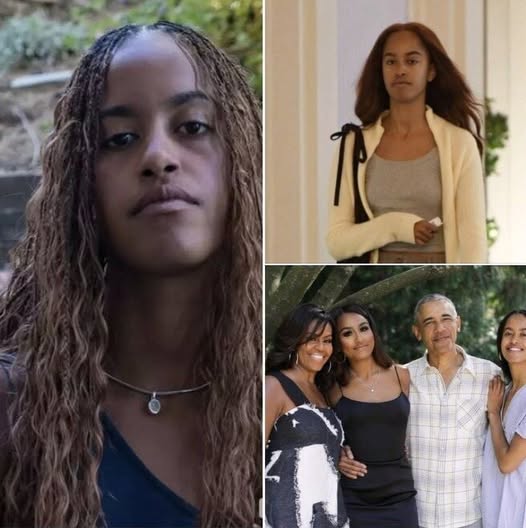

Malia Obama, the eldest daughter of former U.S. President Barack Obama and former First Lady Michelle Obama, is gradually building a creative career in the film and entertainment industry under a professional identity that allows her to establish herself beyond the enormous public profile of her family. Rather than relying entirely on the Obama name, she has chosen to work professionally as “Malia Ann,” using her middle name as part of her identity in Hollywood. This decision has attracted attention because it reflects a broader effort to develop a career based on her own interests, abilities, and creative ambitions.
Growing up as the daughter of one of the most recognizable political figures in the world inevitably placed Malia Obama in the public spotlight from a young age. During her father’s presidency, from 2009 to 2017, she and her younger sister, Sasha Obama, were frequently photographed and discussed in the media. Although the Obama family generally attempted to protect their daughters’ privacy, their lives were subject to considerable public attention. As Malia moved into adulthood, however, she increasingly began to pursue her own interests away from politics and toward the creative arts.
Malia’s interest in filmmaking became particularly visible during her university years and through her early professional experiences. She studied at Harvard University, where she graduated in 2021. Her academic background provided an opportunity to explore interests outside the political world associated with her family. Instead of pursuing a conventional public-facing career connected to politics, Malia began developing experience in film and television production.
Her professional work has included positions in writers’ rooms and production environments, giving her exposure to the practical side of filmmaking. Before establishing herself as a writer and filmmaker, she worked on television projects and gained experience behind the scenes. These early opportunities allowed her to learn about storytelling, production, and collaboration within the entertainment industry.
The decision to use the name “Malia Ann” professionally is especially significant because the Obama surname carries enormous cultural and political recognition. The name itself can immediately attract attention, create expectations, and influence how the public interprets a person’s accomplishments. By using “Malia Ann,” she appears to be creating some separation between her professional identity and the political legacy of her family. This does not mean that she is rejecting her family or attempting to hide her background. Instead, the choice can be understood as part of an effort to create a distinct professional identity.
In the entertainment industry, where personal branding can play an important role, establishing an identity separate from a famous family can be complicated. Malia has the advantage of having access to opportunities that many aspiring filmmakers may struggle to obtain, but she also faces an unusual level of scrutiny. Every project she joins can attract attention because of who she is rather than solely because of the work itself. Using “Malia Ann” may therefore allow audiences and industry professionals to encounter her creative work with slightly less emphasis on the Obama name.
Her approach also reflects a broader issue surrounding children of famous public figures. Individuals born into prominent families often have to balance the advantages of their backgrounds with the challenge of developing independent identities. Fame can open doors, but it can also create assumptions about whether a person’s success is based on talent, family connections, or both. For Malia, working under a different professional name may be one way of emphasizing her own creative ambitions while maintaining a degree of personal privacy.
Malia’s transition into filmmaking is also notable because she has chosen a field that requires a different kind of public recognition from politics. Rather than standing in front of cameras as a political spokesperson or public figure, she has shown interest in storytelling and production. Filmmaking involves writing, directing, collaboration, and the development of ideas over long periods. It can provide a platform for exploring social issues, relationships, culture, and personal experiences without necessarily making the creator the central focus of the project.
Her early work has demonstrated an interest in storytelling rather than simply celebrity. She has been involved in film and television projects in creative roles, including writing. In 2024, she presented a short film titled The Heart, which she wrote and directed. The project was associated with the Sundance Film Festival, where she was credited under the name Malia Ann. The film’s presentation provided an opportunity for her to be recognized for her creative work while reinforcing the professional identity she had chosen.
The use of “Malia Ann” therefore represents more than a simple change in how her name appears in credits. It is part of a larger transition from being primarily known as the daughter of Barack and Michelle Obama to becoming an emerging creative professional with her own goals. Her family background will inevitably remain part of her public story, but her professional activities increasingly provide another dimension to her identity.
At the same time, it would be unrealistic to suggest that Malia can completely separate herself from the Obama family legacy. Her upbringing, education, and opportunities have been shaped by circumstances that are unusual for most people. Her connection to one of the most influential American political families of the modern era will continue to attract public interest. However, acknowledging that background does not diminish the fact that she can pursue her own interests and develop a career in a field of her choosing.
Malia Obama’s emerging career is therefore an example of the complicated relationship between family legacy and individual identity. By working as “Malia Ann,” she has created a professional name that gives greater emphasis to her own identity while still remaining connected to her personal history. Her movement into film suggests that she is interested in building a career through creative work rather than depending exclusively on her family’s public reputation.
As she continues to develop as a filmmaker and writer, her future work will likely receive attention both because of its artistic qualities and because of her background. The challenge for her will be to establish a body of work that can be discussed on its own terms. Whether audiences ultimately know her primarily as an Obama or as a filmmaker named Malia Ann will depend largely on the projects she creates and the creative voice she develops over time. For now, her decision to pursue film under a professional identity of her own marks an important step toward building a career that reflects her personal interests and ambitions.